Wear-resistant rubber sheet is widely used to protect mining and mineral-processing equipment from sliding abrasion, repeated impact, vibration and continuous bulk-material flow. However, selecting a mining rubber sheet is not simply a matter of choosing the thickest roll or the lowest price per square metre. The correct solution depends on the ore, particle size, drop height, flow angle, operating temperature, equipment geometry, installation method and maintenance plan.
This guide explains how procurement teams, maintenance engineers and equipment manufacturers can specify a wear-resistant rubber sheet or custom rubber lining for chutes, hoppers, transfer points, pipes, tanks, pumps and other mining equipment. It also lists the technical information a supplier needs before recommending a practical material and preparing an accurate quotation.

For abrasive slurry pump applications, read the Slurry Pump Rubber Lining Selection Guide before specifying components and replacement scope.
For a pipe-focused specification covering slurry composition, elbows, thickness and installation, see the Slurry Pipe Rubber Lining Specification Guide.
Ore, aggregate, coal, sand and mineral slurry can damage unprotected steel surfaces through several wear mechanisms. Sliding material creates abrasive wear along the direction of flow. Large or sharp particles create local impact at loading zones. Wet material and slurry can combine abrasion with chemical or environmental exposure. Vibration and repeated deformation can also loosen unsuitable fastening systems.
A resilient rubber lining absorbs part of the impact energy and provides a sacrificial wear surface between the processed material and the equipment structure. In many applications, rubber can also reduce noise and vibration compared with a bare metal surface. The value of the lining is therefore measured by equipment protection, maintenance access and operating suitability, not only by the initial sheet price.
Wear-resistant rubber sheet may be supplied in rolls, cut panels or fabricated lining sections. Common mining and bulk-material-handling applications include:
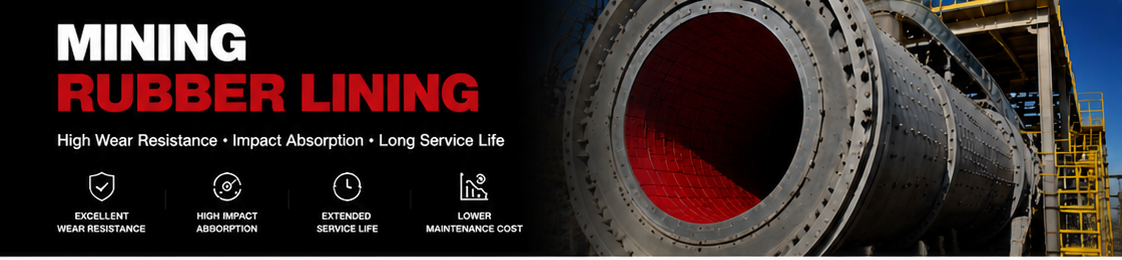
Natural rubber is commonly considered for mining wear applications because of its resilience and abrasion performance under suitable conditions. That does not mean one natural-rubber formulation is correct for every mine. Compound selection should be reviewed against the actual service environment.
Before choosing a material, confirm whether the lining will contact oil, fuel, chemicals, high temperatures, outdoor weather or other media that may affect rubber. Where these conditions are present, a different rubber family or a purpose-designed compound may be required. The supplier should evaluate the complete application instead of assuming that the phrase "wear resistant" defines all necessary properties.
Buyers should also distinguish between a general-purpose rubber sheet and a mining lining material intended for repeated abrasion and impact. Product appearance alone does not demonstrate suitability. Request the relevant technical properties for the proposed grade and compare them with the actual operating conditions.
Thickness is one of the first questions in a mining rubber sheet enquiry, but it cannot be selected independently. A thicker sheet provides more wear allowance, yet it also changes weight, flexibility, available clearance, fastening requirements and installation effort.
For a useful thickness recommendation, provide the particle size distribution, approximate drop height, flow speed, loading frequency and location of the main wear zone. A lightly loaded sliding surface and a high-impact transfer point may require different lining layouts even when they handle the same ore.
The available space inside the chute or equipment must also be checked. Excessive lining thickness can reduce the flow area or interfere with adjacent components. Conversely, a thin sheet chosen only to reduce initial cost may provide insufficient wear allowance in a severe zone. Where wear is concentrated, a zoned lining design can be more practical than applying one thickness to every surface.
Hardness is often included in rubber specifications, but it should not be treated as a single measure of wear life. Softer rubber may deform and absorb impact effectively in some applications, while a harder material may provide dimensional stability in others. Abrasion resistance, tear behaviour, tensile properties, resilience and compound quality all contribute to performance.
Instead of requesting "the hardest rubber", describe how the material strikes and moves across the surface. Is the wear mainly sliding, cutting, gouging or direct impact? Are the particles fine and continuous, or large and intermittent? Does material fall vertically or travel at a shallow angle? These details help the supplier interpret hardness together with the complete mechanical duty.
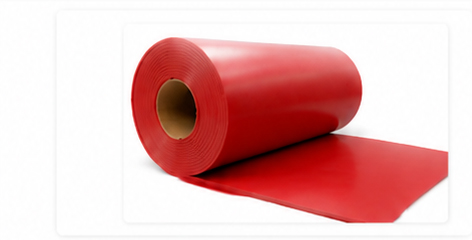
Standard rolls are useful when the installer will cut simple flat panels on site. Complex equipment may require templates, cut pieces, holes, bevelled edges or moulded components. Accurate dimensions reduce waste and help ensure that joints, corners and fastening positions match the equipment.
For flat sheet requirements, state the thickness, width, length and quantity. For fabricated linings, provide a drawing with dimensions and identify the material-flow direction. Photos are helpful, but they should support rather than replace dimensional drawings. Mark high-wear zones, access restrictions and any surfaces that must remain clear.
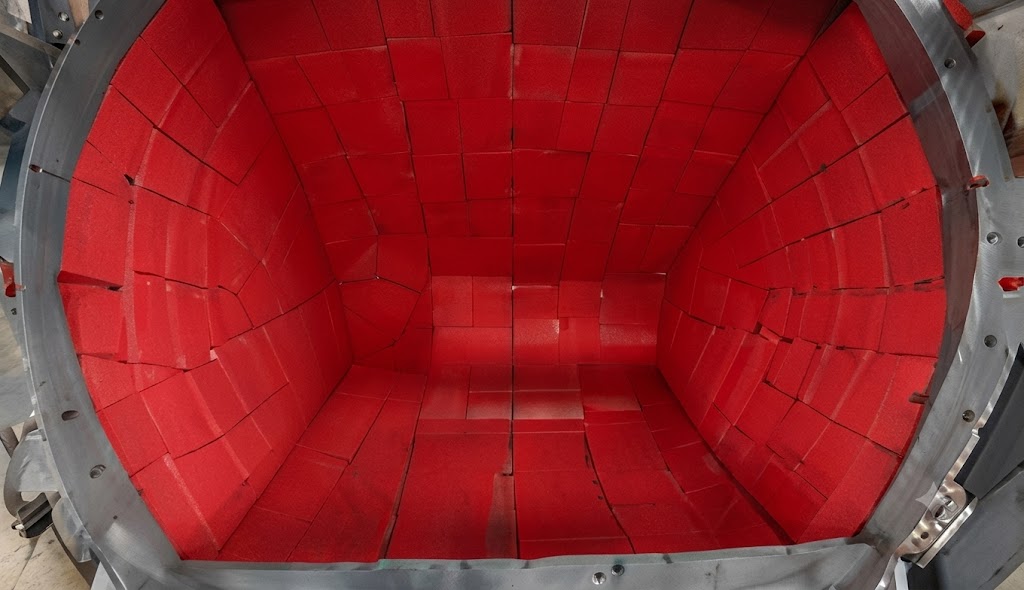
Large internal surfaces may require several panels. Joint location then becomes part of the design because an exposed upstream edge can receive direct material flow. The installer should plan panel orientation, overlaps or joint treatment according to the equipment and chosen attachment method.
Rubber sheet can be attached by bonding, mechanical fastening or a combination of methods. The suitable approach depends on surface condition, panel size, equipment movement, operating environment and future replacement requirements.
Bonding can create a continuous lining on a properly prepared surface. Surface preparation, cleanliness, adhesive compatibility, temperature and curing conditions are essential. An apparently flat installation can still fail if contamination, moisture or unsuitable preparation prevents adhesion.
Mechanical fastening can simplify removal and replacement in accessible equipment. Fastener heads, edges and holes must be positioned so they do not become premature wear points. The support structure must also be suitable for the selected fastening arrangement.
In equipment with predictable local wear, replaceable panels can support planned maintenance. A modular layout allows the most exposed section to be changed without removing the entire lining. The panel design should still account for joints, flow direction and safe maintenance access.
Chutes and hoppers often contain several different wear zones. The feed area may experience direct impact, the side walls may experience sliding abrasion, and the outlet may experience concentrated flow. Treating the whole assembly as one uniform surface can overlook these differences.
A useful chute-lining review therefore starts with a simple flow map. Identify the point where material first contacts the equipment, the direction it travels, where it changes direction, and where it accelerates or accumulates. Then compare these zones with the existing wear pattern. This information supports a more targeted choice of rubber thickness, panel size and attachment method.
For more detail about transfer-point selection, read our Rubber Chute Liners for Mining Selection Guide.
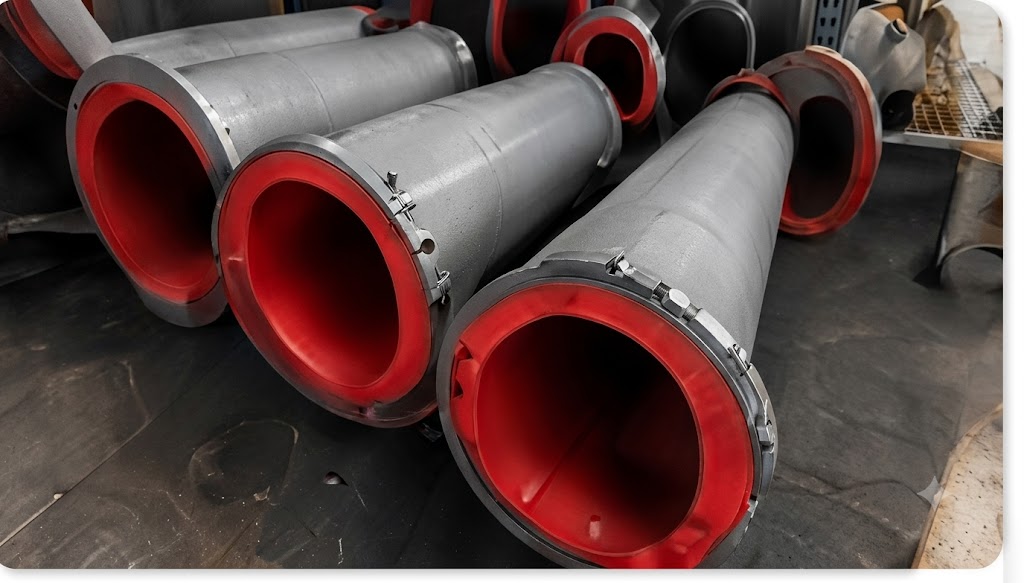
Pipes, tanks and slurry-handling equipment require attention to internal diameter, flow velocity, slurry composition, particle characteristics and connection geometry. A lining changes the internal dimensions of the equipment, so the design must consider both wear protection and process requirements.
Curves, branches, inlets and outlets can have different wear patterns from straight sections. Drawings should identify these features, together with flange faces, sealing areas and dimensional tolerances that must remain functional after lining. For replacement components, photographs of the worn part and the previous service history can help explain the failure mode.
Even a suitable rubber compound can underperform if the installation is poorly planned. Before installation, inspect the substrate for corrosion, sharp edges, contamination and dimensional problems. Confirm that the surface-preparation and attachment procedures are compatible with the rubber and the equipment.
After commissioning, inspect the lining at planned intervals. Record wear depth and location instead of relying only on general visual impressions. A simple inspection history helps identify whether wear is uniform, concentrated at one edge, caused by impact, or associated with a loose joint or fastener.
When replacement is required, compare the observed wear pattern with the original operating assumptions. Changes in ore, throughput, particle size or transfer height may explain why a previously acceptable lining now wears differently. This feedback is valuable for the next specification.
Include the following information in your enquiry so the supplier can review the application efficiently:
When some values are unknown, describe the operating problem and provide the available evidence. A worn-panel photo, material-flow sketch and basic dimensions are more useful than requesting a generic "best quality mining rubber sheet" without context.
No. Natural rubber is widely considered for abrasion and impact applications, but exposure to oils, chemicals, heat or other conditions may require a different compound. The complete service environment must be reviewed.
Not automatically. Thickness affects wear allowance, weight, flexibility, clearance and installation. It should be selected against the wear severity and equipment design.
It may be possible to cut and fit flat panels, but complex geometry can require templates, fabricated sections or a planned panel layout. Drawings are needed to evaluate the practical option.
The application, handled material, particle size, impact or sliding conditions, dimensions, quantity and drawings are the most useful starting points. Temperature and chemical exposure should also be stated.
Compare the proposed material, dimensions, tolerances, fabrication scope, attachment assumptions, packaging and technical documentation on the same basis. A lower price may reflect a different scope rather than an equivalent product.
Qihang Rubber supplies wear-resistant natural rubber sheet and application-specific mining rubber lining for industrial equipment. Our review starts with your application conditions and dimensional requirements so that the quotation is based on a defined scope.
For equipment-specific thickness and Shore A planning, read the Mining Rubber Lining thickness and hardness selection guide.
Send the equipment type, handled material, operating conditions, dimensions, quantity, drawings or photos and destination through our contact form. You can also review our overview of mining rubber lining for wear-resistant equipment protection before preparing your enquiry.
Tianjin Qihang Plastic Technology Co., Ltd
12+ Years Expertise in Industrial Rubber Sheet Manufacturing • Global Export Leader • REACH/RoHS Certified
...[ Read More >>]


